Punctuality and precision
Around the World in Eighty DaysPunctuality and precision are both Phileas Fogg’s daily discipline and the governing logic of his wager to travel around the world in eighty days. They make his life appear perfectly measurable: shaving water must be delivered at a specified temperature, trains and steamers must connect, and the deadline is fixed to the minute. Yet the same precision becomes vulnerable when a journey around the globe makes calendar time diverge from the time Fogg believes he has kept. The ending turns his apparent failure into a victory through one overlooked day.
Domestic discipline and daily routine
At home, Fogg’s demand for exactness reaches into the smallest detail. On 2 October he dismisses his servant James Forster because the shaving water arrives at eighty-four degrees Fahrenheit rather than eighty-six. The difference is only two degrees, but Fogg treats it as sufficient cause for dismissal. His standards make the household a place of rigorous routine, where the servant is expected to be almost superhumanly prompt and regular.
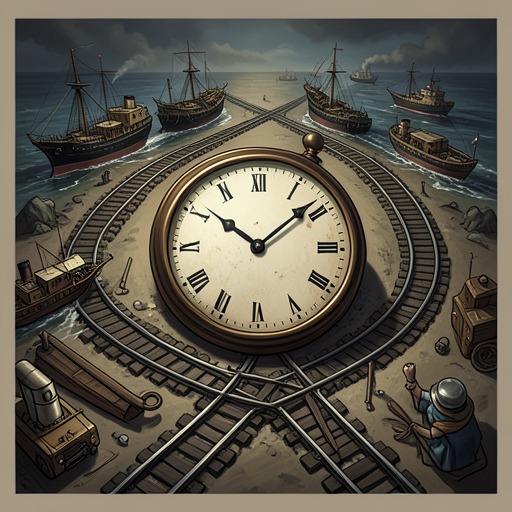
Fogg’s own posture and habits reinforce the impression of a life governed by measured time. He sits upright, hands on his knees, watching a complicated clock that marks not only hours, minutes, and seconds, but also days, months, and years. At precisely half-past eleven, he ordinarily leaves his London home for the Reform Club. The clock’s broad reach across units of time seems to promise comprehensive control: every part of the day, and even the calendar, appears legible to its owner. The ending will expose a gap between recording a date and understanding how that date changes during travel.
Precision as a travel method
Fogg carries his habits of calculation from domestic life into the wager. When challenged that eighty days is merely the shortest estimated time for the journey, he maintains that a well-used minimum is enough. The route demands that he move mathematically from trains to steamers and back again; he accepts that formulation rather than treating the connections as an obstacle to his plan. Precision here is not simply care with small details. It is a method for turning the world’s transport network into a timed sequence.
The schedule depends on particular speeds and dates. Aboard the General Grant, a large, fast paddle-wheel steamer, the crossing of the Pacific is expected to take twenty-one days at twelve miles an hour. On that basis Fogg hopes to reach San Francisco by 2 December, New York by 11 December, and London on 20 December, gaining several hours before the fatal deadline of 21 December. The schedule is expressed in hours, miles, and calendar dates alike. Its apparent exactness makes the plan seem secure, but the calculation of an itinerary does not by itself account for the way eastward travel alters the traveler’s reckoning of days.
Clocks, watches, and competing time
The contrast between Fogg’s clock and Passepartout’s family watch makes the story’s concern with measurement concrete. When Fogg warns Passepartout not to miss a steamer, Passepartout checks his watch and believes it is only eight minutes before ten, although he has been told it is noon. Fogg identifies the immediate problem: the watch is slow. The watch is personal and inherited, but its sentimental continuity does not guarantee that it will serve the journey’s practical demands.
At the end, the same watch acquires a more consequential meaning. It has always kept London time, and so could have revealed the discrepancy if it had marked the days as well as the hours and minutes. It measures a local standard faithfully while failing to register the change that matters most to the wager. The distinction is not simply between a reliable and an unreliable instrument: even accurate clock-time can be inadequate when the question is how many calendar days have elapsed across a journey eastward.
The apparent failure
Fogg’s return initially seems to confirm that his precision has failed. On Sunday, for the first time since living in the house, he does not leave for the Reform Club at half-past eleven. He believes he missed the appointed gathering on Saturday evening, when the five men who made the wager were waiting in the club’s great saloon. By 8:20, one of them notes that only twenty minutes remain before the agreed time expires. Fogg’s absence appears decisive; his opponents already hold his cheque, and the public expectation is that he has lost.
At home, Fogg shuts himself in his room and puts his affairs in order. Passepartout repeatedly goes up and down the stairs, listens at Fogg’s door, and fears that something terrible might happen. Even Fix is no longer an object of anger in Passepartout’s thoughts: he recognizes that Fix had mistaken Fogg for the bank robber and had performed his duty by pursuing and arresting him. The quiet, anxiety-filled day gives the supposed defeat a human cost, while Fogg’s continued composure offers no visible sign that he suspects a different explanation.
The gained day and the reversal
The explanation is that Fogg has gained a day without knowing it by traveling constantly eastward. As he moves toward the sun, the local days diminish by four minutes for each degree crossed. The circumference of the earth contains 360 degrees; multiplied by four minutes, that makes twenty-four hours. Fogg has therefore seen the sun pass the meridian eighty times during the journey, while his friends in London have seen it pass seventy-nine times. They expected him at the Reform Club on Saturday, while he believed that the relevant day was Sunday.
This reversal makes precision both the source of the suspense and the instrument of its resolution. Fogg’s punctuality has organized the journey around a deadline, yet his reckoning initially omits the global frame that determines the correct date. He does not win by accelerating beyond his own schedule at the last moment; he has already completed the journey within eighty days and misread the day on which he returned. The novel’s final calculation distinguishes exactness from complete understanding: a clock can count every second correctly and still leave a traveler one day wrong.